
Read no. 1
The text
Content note. This issue references a band whose original name included language now recognized as a slur. It has been replaced in this database display with "Born G____," though the uncensored form remains in historical documentation.
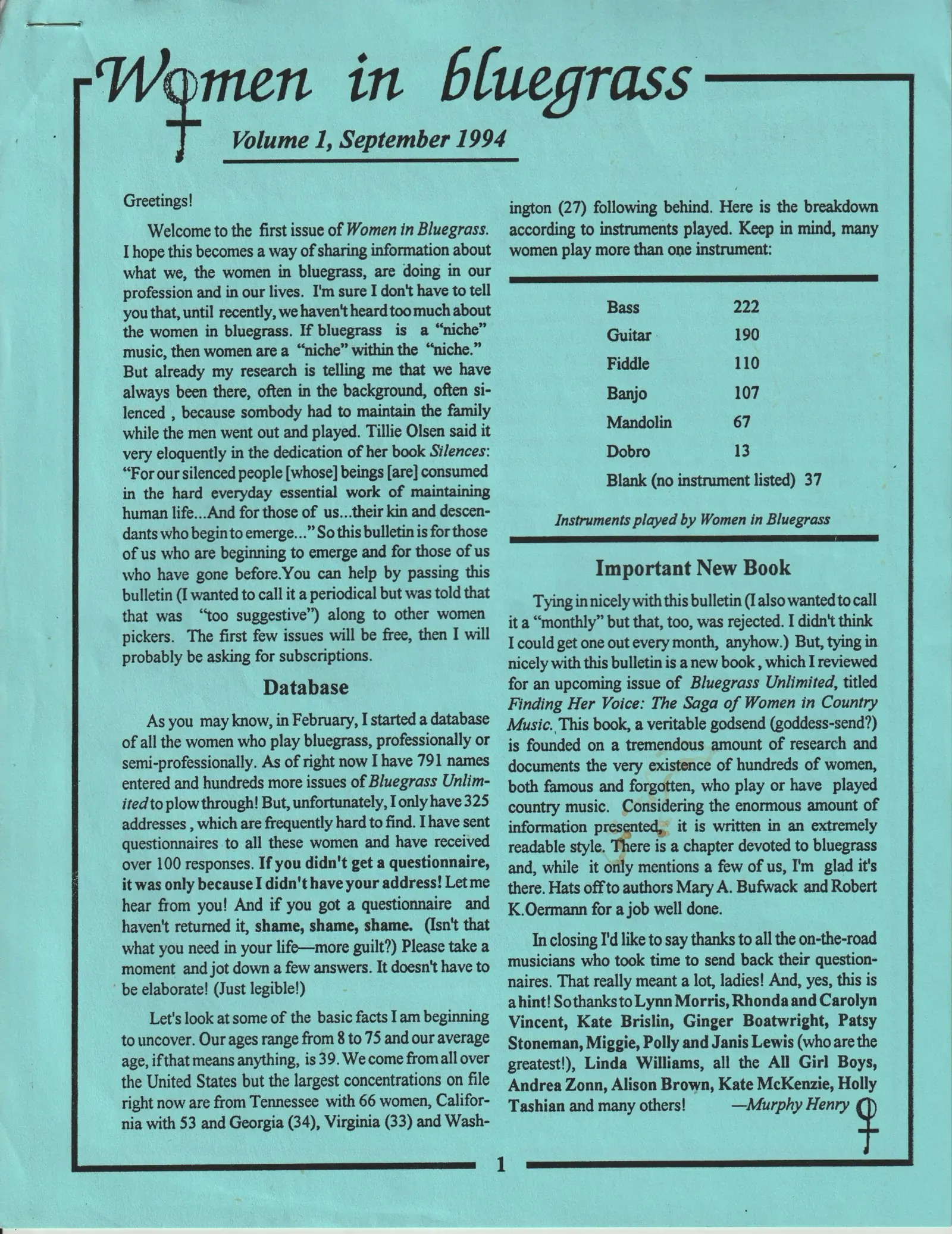
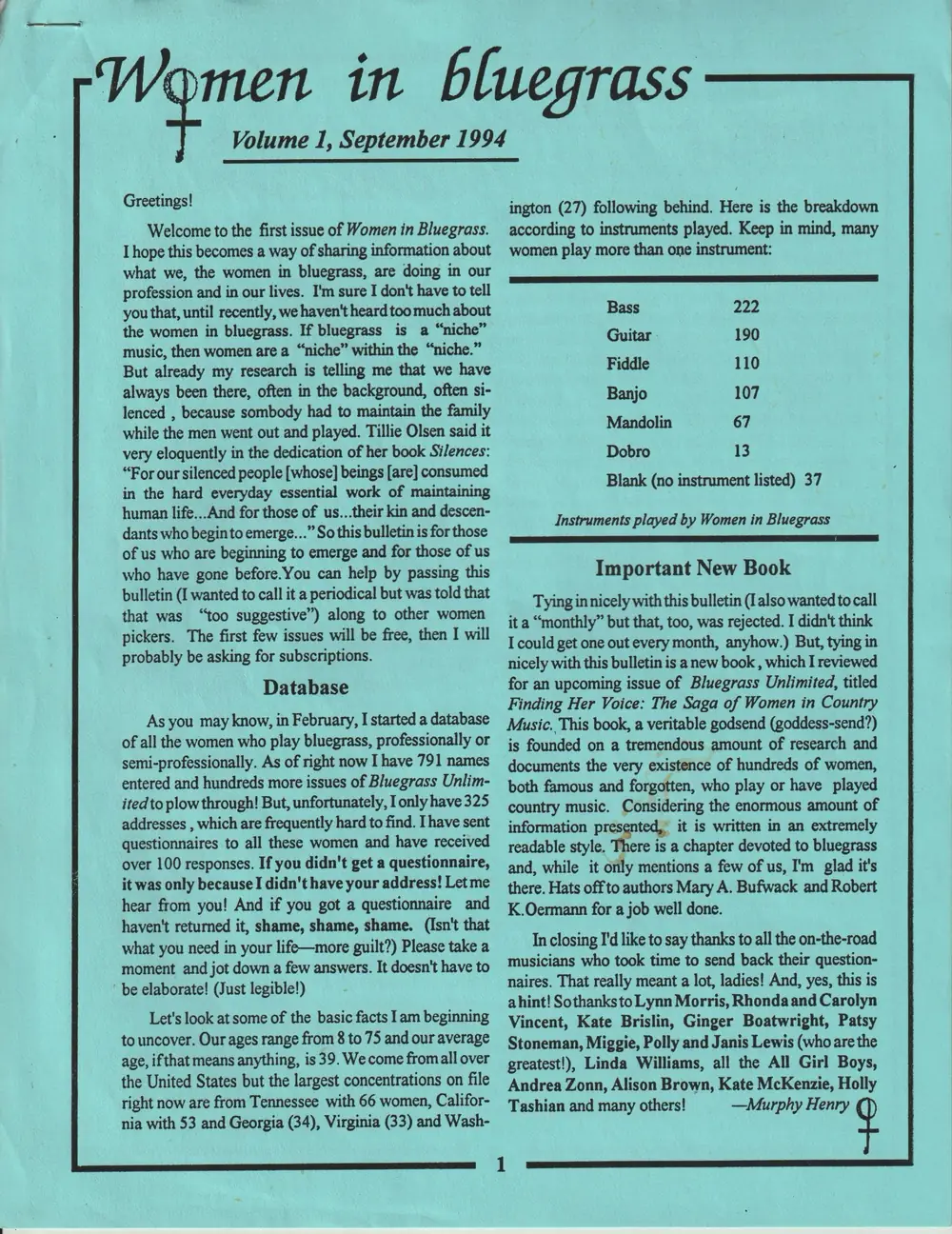
Greetings!
Welcome to the first issue of Women in Bluegrass. I hope this becomes a way of sharing information about what we, the women in bluegrass, are doing in our profession and in our lives. I'm sure I don't have to tell you that, until recently, we haven't heard too much about the women in bluegrass. If bluegrass is a “niche” music, then women are a “niche” within the “niche.” But already my research is telling me that we have always been there, often in the background, often silenced, because somebody had to maintain the family while the men went out and played. Tillie Olsen said it very eloquently in the dedication of her book Silences: “For our silenced people [whose] beings [are] consumed in the hard everyday essential work of maintaining human life...And for those of us...their kin and descendants who begin to emerge... ” So this bulletin is for those of us who are beginning to emerge and for those of us who have gone before. You can help by passing this bulletin (I wanted to call it a periodical but was told that that was “too suggestive”) along to other women pickers. The first few issues will be free, then I will probably be asking for subscriptions.
Database
As you may know, in February, I started a database of all the women who play bluegrass, professionally or semi-professionally. As of right now I have 791 names entered and hundreds more issues of Bluegrass Unlimited to plow through! But, unfortunately, I only have 325 addresses, which are frequently hard to find. I have sent questionnaires to all these women and have received over 100 responses. If you didn't get a questionnaire, it was only because I didn't have your address! Let me hear from you! And if you got a questionnaire and haven't returned it, shame, shame, shame. (Isn't that what you need in your life—more guilt?) Please take a moment and jot down a few answers. It doesn't have to be elaborate! (Just legible!) Let's look at some of the basic facts I am beginning to uncover. Our ages range from 8 to 75 and our average age, if that means anything, is 39. We come from all over the United States but the largest concentrations on file right now are from Tennessee with 66 women, California with 53 and Georgia (34), Virginia (33) and Washington (27)
following behind. Here is the breakdown according to instruments played. Keep in mind, many women play more than one instrument:
Bass 222
Guitar 190
Fiddle 110
Banjo 107
Mandolin 67
Dobro 13
Blank (no instrument listed) 37
Important New Book
Tying in nicely with this bulletin (I also wanted to call it a “monthly” but that, too, was rejected. I didn't think I could get one out every month, anyhow.) But, tying in nicely with this bulletin is a new book, which I reviewed for an upcoming issue of Bluegrass Unlimited, titled Finding Her Voice: The Saga of Women in Country Music. This book, a veritable godsend (goddess-send?) is founded on a tremendous amount of research and documents the very existence of hundreds of women, both famous and forgotten, who play or have played country music. Considering the enormous amount of information presented, it is written in an extremely readable style. There is a chapter devoted to bluegrass and, while it only mentions a few of us, I'm glad it's there. Hats off to authors Mary A. Bufwack and Robert K.Oermann for a job well done.
In closing I'd like to say thanks to all the on-the-road musicians who took time to send back their questionnaires. That really meant a lot, ladies! And, yes, this is a hint! So thanks to Lynn Morris, Rhonda and Carolyn Vincent, Kate Brislin, Ginger
Boatwright, Patsy Stoneman, Miggie, Polly and Janis Lewis (who are the greatest!), Linda Williams, all the All Girl Boys, Andrea Zonn, Alison Brown, Kate McKenzie, Holly Tashian and many others! —Murphy Henry
Spotlight on... Louisa Branscomb
Many of you may know Louisa Branscomb as the writer of Steel Rails, a big song for Alison Krauss. This was not a fluke, for Louisa has been writing songs since she was a child. Born in 1949 and raised in Alabama, she began playing bluegrass at age 18 on guitar and started banjo at age 21 when she was at Randolph Macon College in Lynchburg, Va. After graduation, she moved to Winston-Salem, N.C., and, in 1971, formed one of the first all-female bluegrass groups, Bluegrass Liberation, in which she
played guitar. She and Sam Sanger formed Boot Hill in 1973 and Louisa played banjo with them for eight years, cutting three albums which featured many of her original songs. After Boot Hill, she also played in another all-female band, Cherokee Rose. Louisa has a Ph.D. in clinical psychology and is a practicing psychologist in Decatur, Ga. She now leads her own band, Born G____, and has recently adopted a daughter, Olivia, who is one-and-a-half.
Louisa was one of the first women I ever saw playing the banjo way back in the 70s. Did we rush up to each other, strike up a fest friendship and spend time talking about our unique occupations? No, we did not. Like many bluegrass women, we were either too shy to speak or just too busy. But I did listen to her show long enough to pocket the word “skyway” from a line in her song Sweet Virginia: “black-top highway, Blue Ridge skyway” to be used later in my own Pall Mall Reds.
It wasn’t until Owensboro 1992 that I really got to know Louisa. We reacquainted ourselves and had a lovely, small jam session one night, sitting in the hall. A few months later at SPBGMA, (February 1993), we had a full-fledged, all-women jam session right in the exhibit hall. Louisa was the first woman I had ever met who could take lead breaks in a jam on three different instruments. She didn’t have to be begged, she didn't make a fuss, she didn’t apologize (except for her singing: “I’m not a lead singer,” she says), she just played. We spent several magical hours, passing instruments back and forth, trading breaks on guitar, banjo, mandolin, whichever one we happened to be holding at the time. We had five women available to sing (my sister, Nancy Hicks Pate, Jane Baxter and her mother Onie Baxter were the others—all powerful singers) and we sang in C, we sang in D, we sang in E, we sang wherever we wanted to in three-part harmony and we had a ball.
This experience intensified my interest in Women in Bluegrass. So, Spotlight on Louisa! I hope that this will please her! (You have to be from Georgia to make that rhyme!) This interview has been severely edited to make it readable because, in the manner of women everywhere, Louisa and I talked on top of each other, finished each other’s sentences and constantly interrupted each other. It was wonderful! As you see, we skipped the trivia and jumped right into the good stuff!
Did you ever see any women that were better than you when you were playing? [Other than Bluegrass Liberation] I never saw women playing except you and I didn’t see you until Hatchett Creek [around 1976].
I remember seeing you, too, and we didn't interact, did we?
I don’t remember. That might have been the festival when I had a crack in my banjo head and I might have asked you where I could get a banjo head.
Isn't it interesting that here we have two women playing the banjo...
Oh, I was terribly shy, though, with anyone. Even when I tried to introduce myself to Alison Krauss, I just about died. I didn’t even know she did my song. I was very, very introverted during all those years.
Even though you were able to overcome that and play on stage?
Yes, but playing on stage was real hard for me and I didn’t ever play real loose on stage. I’ve only come into that more recently and it seems for some reason it’s easier for me on mandolin but that’s probably just because I haven’t played as much banjo in the last few years. It’s hard for me to be loose and play fast but you know, Murphy, I didn’t learn til I was 21...
Can you talk a little about any problems you had with men?
I don’t know how to say this, because it’s a two-edged sword. On the one hand I felt respected in the professional sense, in the sense that fans and musicians always had a respectful attitude, but underneath there were currents: “Can she really play?”, “What is she doing?” or “What does she think she’s doing?” (which is worse), or ‘What is she trying to prove?” It is true that Boot Hill got rejected from a major festival because we had a woman playing the banjo but I didn’t get any direct hostility. I never really got what I would call sexual harassment.
What about jam sessions and competition with men? That's why I enjoyed picking with you at SPBGMA. I didn't feel any competition.
No, it’s like we’re having a conversation. But, speaking as a psychologist, it is also true of women’s ways of relating. Women come from a relational position as part of our gender development and I think it’s encouraged by our mothers for some reasons that pay off positively and some that pay off negatively (like we have to take care of everybody else). The other side of that is the patriarchal culture that has discouraged women from networking with each other because it threatens the idea that women need to focus on getting a man. But our natural way of relating is in relation to others as opposed to competitive or individualistic.
How did you feel about playing in jam sessions with men when you first started and how do you feel about it now?
I don’t go to jam sessions...well, I rarely go and it’s not so much the woman thing...well, since I’m the only woman how do I know it’s not because of the women thing? I’m trying to see if I can make any generalizations about that. In North Carolina it was a lot less competitive and everybody seemed to enjoy it. Our jam sessions didn’t particularly feel sexist. Now, when people figure out I know what I’m doing they’ll defer...sometimes. And have you ever had this phenomenon? You walk up on about ten people at a festival and there’s a circle. Now there’s a lot of body language and elbowing in this jam session thing, you know, and you aren’t let into the circle. You’re back there playing behind the circle (this is a long time ago and people don’t know who you are) and people are checking you out to see whether you can play. Now a woman may play pretty good but it’s still hard for them to let her in the circle. They’ll sooner let a guy in the circle. Or you become a spectacle. You become a woman banjo player, an anomaly...a throwback (“Look! She can play!”) and then it’s like “Play something, honey” and then you’re put on the spot. Now, why has this been going on so damn long? I mean this is 1994. Because it’s a manifestation of what’s still going on in the culture.
Can you talk about the problems of women singing in bluegrass?
It’s been a non-issue for me, Murphy, because it’s so easy for me to arrange and I would just sing whatever part fell in my range...
What about in jam sessions? That never bothered you? I always wanted to be in control of a jam session so I could do all the singing and I never got to because women don't sing in "conventional" keys.
Well, I think in some ways your personality’s more out there because I never did want to control a jam session. I think my self-esteem wasn’t high enough. You’re extroverted, I’m introverted. There’s a big difference in the way we both would approach a situation. I’m very internal and don’t like crowds and don’t like being out front. I think about everything inside and do a lot of inside digesting.
But yet when we're playing together in a jam session you do kinda...
Oh, I get real excited...
and you can suggest tons of songs.
Yeah, I kinda like bloom ’cause I haven’t had that here in Atlanta...
I wonder if many women have that at all? I think jam sessions are where people network, that’s where bands are formed, that’s where people learn to play and I think that since women don’t have that, we're at a real disadvantage.
I think so too but speaking more generally and from my psychology background, it’s not typical for a woman to even give herself permission to think about “I’m gonna lead this jam session” or “I want to suggest songs.” See, I don’t think your personality style is the norm for women. I think that you somehow got a different set of genes and different support growing up or something. I mean, there were no boys in your family and I don’t know if that made a difference in terms of the way your parents said, “Y’all can do it.” I think so. Mama never told us there was anything we couldn't do.
Well, my mom modeled a different thing, that women are supposed to give in and be passive, the martyr scene. A long time ago I think it was a part of my whole personality makeup of just being shy. I wanted to blend in, I wanted to do good. I wanted to play well, but I’ve always been so focused on the music, I’m not really so focused on the visibility. For me it’s like this intense thing with the music and it’s just between me and the music. You’d be more like bouncing things off people and it’d be me and my guitar...me and my banjo.
That's probably one thing that makes you such a good songwriter...
And probably band leader because I’m so into the music. It’s also my liability as a band leader because people think that I’m controlling when the music is my passion. It’s easy for me so I’ve had to kinda go back and become more aware of how to deal with people’s personality variables and work with that and get the music done correctly. In a lot of what I'm reading now, feminists are saying that the younger women don't see what the older generation has done. They don't see the doors that have been opened. Oh, I had a conversation with a young woman at the IBMA business meeting last year. The issue of women’s bands came up and a few real hostile things were said [by her] such as “I’ve had enough of these all women bands and I think that’s a gimmick and women need to get past doing that and we need to get over it and realize we’re equal with everybody else and not try to prove a point.” So, I went up to her afterwards and I said, “How old are you?” And she said, “26” or something. I said, “Well, I’m 45 so I was
playing about the time you were born and I think it’s too early for us to say ‘get over it.’ I don’t believe there’s been enough change yet. It’d be kinda like in the Civil Rights movement telling blacks in 1963 to get over it... that if they just wouldn’t act like a minority, they wouldn’t be a minority.” And she listened and we had a little intense conversation, not an altercation, but I just had to say it, normally I wouldn’t say anything...
Our talk about the IBMA also elicited this comment from Louisa:
“Well, at some point there’s gonna be a bluegrass women’s hall of fame and all of that, it’s just going to take another fifteen years.”
You think so?
Sure, why not? Women need to get special recognition where there’s been special silence. That’s my feeling and I think that will happen and if you have your database people will know where to get it.
(The above is from an interview with Louisa in her home March 20, 1994.) Update: September 4, 1994: Since our interview Louisa has undergone major surgery for a potential medical problem. She has weathered the storm, and when we spoke on the phone, had just come in from an afternoon of horseback riding and mowing. This was Louisa’s first serious medical illness and has made her realize even more what a precious commodity time is. “I’m not doing anything now unless I enjoy it or unless I feel a moral purpose in it and preferably both. I’m not going to be playing unless it is for a cause I believe in or playing original songs and supporting other songwriters.” Louisa, who enjoys performing with people she likes, for people she likes, is playing some now at a local coffeehouse where she can do just that. Her last performance there included five women, all sharing their original songs. Lately she has asked herself, “What is my purpose as a musician?” and her answer is, “I’m beginning to see myself as a mentor. I want to begin passing the torch and giving my energy to younger players.” Louisa’s own songwriting continues unabated. She describes herself as having “come full circle” as her songs begin to blend the moral and social messages of folk music, which she has written and played since she was 15, with some of the melody and energy of bluegrass. Her next project, a collection of songs related to healing and transformation, will be dedicated to AIDS patients. It was with them in mind that she wrote one of her newest songs, “For Every Day That You Die Young. —Murphy Henry
Ratifications
by Casey Henry
At my mom's suggestion, I will do my painful duty as a daughter and fill up this corner of the page, writing about my favorite subject. Me. Me and my banjo, that is. Owensboro is fast becoming my favorite time of the year. It has even come to surpass my birthday and Christmas. And seeing as how that time is about to roll around, I have been doing my best to prepare for it. This includes shopping for the perfect awards show outfit (which I found), thinking about who I am going to bum a backstage pass off of this year and, of course, trying to cram the entire Scruggs Book into my head. I am slowly starting to accomplish my last goal although it looks like it is going to take a little more than the time I have before IBMA. My latest achievement is Dear Old Dixie. My mom kept telling me it was so challenging that when I finally learned it, I have to admit I was a little disappointed. But the more I play it, the more I like it. The thing I like most about learning Scruggs tunes from my mom is going to the record and fixing her mistakes. This time there were no mistakes. That’s no fun! I’ll have to tell her to do better next time.
Why Did You Start Bluegrass?
—from the questionnaire
Carol Lombardo, from Alaska, says,“I fell in love with the music and the sound of the banjo! I was asked to be the music director for a local performance of “Cotton Patch Gospel.” It was my first and only close exposure to bluegrass music. After weeks of trying to teach what I didn’t know to performers, I gained a real appreciation for bluegrass music—its structure, the sound of it, the emotional impact—and the sound of that banjo went straight to my heart. It took about six months to go from that stuff's great! to I wish I could to could I? to there's no way! to maybe it’s possible to I think maybe I could—big commitment—I think I will—I’m gonna do it—I’m gonna do it come hell or high water! I had no idea what I was getting into—a whole subculture, a whole new music education, a society of new friends, new ways to sing, and hundreds of new old-songs, values, mores, and even geography to learn.”
Well put, Carol. The questionnaire is revealing that many women, such as Carol, are discovering bluegrass as they pass into the "second phase" of their lives. Carol, a vivacious red-head, started banjo when she was fifty, after she got the youngest of her
five children (four boys!) into high school. She is extremely active in the Alaska bluegrass scene, has played bass with two bands, Gold Rush and Whitewater, and dragged her husband, Frank, to Owensboro in 1993, where he fell in love with the music, too, and started learning to play bass. After Carol gets through with her daughter’s wedding this fall, she hopes to devote more time to the banjo! Go Carol! Mary Ann Cornelius who lives in San Antonio, Texas says: “Janet Davis [Banjo Newsletter columnist, banjo player and teacher, and owner of Janet Davis Music] bought a bass, said she needed a bass player, and she had a gig in a couple of months.” She played bass on Janet's album, too. The liner notes say she "has always longed to be a ‘torch singer.' Naturally, we made her the bass player. However, we still find her staring longingly at torches from time to time."
Guest Columnist
Nancy Hicks Pate
My sister, Nancy Hicks Pate, a fine writer of both poetry, in the form of song, and of prose, (she has recently completed a novel which she is shopping around to publishers), appears here as a woman who has put several careers on hold to concentrate on raising her two daughters, ages six months and almost three years, with the help of her husband, Rad. When she showed me a song she had written describing her lifestyle, I knew I wanted to print it here. I wish you could hear her sing it. But, let her tell you about it. —MH
Breathing Out
When I finally finished my higher education, I left behind the bluegrass band (Red and Murphy & Co.) of which I had been a member for eight years. I moved from Florida to Atlanta, Georgia, and thought I was leaving the world of bluegrass behind forever. After all, I had a job in my field, a 9 to 5 job for the first time in my life. And I knew only one other bluegrass musician in Atlanta.
To my surprise, though, my one bluegrass connection soon called to invite me to pick with a bunch of talented women, and I found myself performing the occasional benefit or wedding with them. That musical spurt soon petered out, however, under the pressures of changing jobs, getting married, and then, having our first baby. Having a child reinforced some of my naturally unsociable habits. It was so much easier to stay home in the evenings. I could always use the sleep. And then there’s the baby-sitting trade-off
dilemma—if my husband babysits tonight while I jam, how can I ask him to sit tomorrow while I see a friend, see a movie or get my hair cut?
Then one night when my daughter was not quite a year old, I got a phone call offering me the chance to be part of a regular band. And though I'm very cautious about forming new ties, and a stick-in-the-mud as aforesaid, my desire to make music won out. I said yes.
I have found that playing music for me is like trying to follow an exercise program. It’s hard to get started, hard to get out the door and go, but I always feel better for doing it. This new group I’m playing with (Born G____) is semi-professional. We play very few gigs. We practice once a week for a while, then skip a month. We even took three months off when my second baby came along. But the important thing for me is that I’m singing again. And when I sing, I play the guitar. And when I have the guitar in my hands, even if it’s only once a week, songs come to me and I write. That’s the best part. The lyrics of my latest song came to me one night in the car, driving home from practice. It has often struck me that the life I lead now is a severe contrast to my years as a travelling musician. I loved going on the road. I thought every cheap motel was an adventure. I enjoyed meeting people at bluegrass festivals and then not seeing them for another year. But the jobs I loved the best were when we played the bars. You know the line in the movie “Silverado” when Kevin Kline’s character says, “I love a good saloon”? Well, me too. I’m not much of a drinker. But it tears me up that cigarettes are bad for you, even second hand lounge smoke. I liked playing the sets, taking breaks to chat with a friend or a fan, or just sit in a corner and have a beer. Then the band gets back up to play some more until it’s time to pack up and emerge from the neon haze to drive home under a sky full of stars. I miss those late nights. Of course, I don’t miss the packing up.
Anyway, sometimes I regret that my husband doesn’t know this side of me, just like I regret not knowing what he was like as a small boy. So I wrote a song to express that regret and my nostalgia for that old road life. As an explanation of the first line, for those of you who don’t know the Florida folk musician, the late Gamble Rogers, just think of your own frustration at not being able to flip on the radio and hear good acoustic music any time of the day.
Now that I’m playing again, even sporadically, it’s easy to believe I’ll be making music for the rest of my life...as long as my phone keeps ringing.
Breathing In
Driving down the highway I'm no longer filled with woe
Because I can’t find Gamble Rogers on my radio.
Once I was a singer, spent my nights in dimlit bars,
Drinking beer and smoking cigarettes beneath the neon stars.
My friends and I would stay up ‘til all hours of the night
Playing cards or playing music 'til we saw the morning light.
Now the only songs I sing are for my children‘s ears,
Had a glass of wine last Christmas, but I haven't smoked in years.
Ain't been up past midnight since the baby learned to sleep;
I'm usually in bed by nine with the covers piled on deep.
CHORUS:
He says he loves me anyway.
I know I love him and I love the land,
Love our two daughters whom we've raised by hand.
Never sought the road I’m on, but I sure like where it's been—
The living's hard, but the loving’s easy—
Like breathing out and breathing in.
Driving down the highway I’m no longer filled with woe
Because I don't hear my songs playing on the radio.
Once I lived in solitude, I liked to be alone
Couldn't stand to talk at breakfast or on the telephone.
I’d walk the woods for hours followed only by the wind;
Ignoring time and distance. I’d explore each pathway’s bend.
Now I slow my steps to match the small ones at my side
Aware of naptimes, mealtimes and a tired faltering stride.
I answer twenty questions with my morning cup of tea.
Boy, the house seems empty when they ’re gone and it's Just me.
Driving down the highway I'm no longer filled with woe
Because I can't hear Gamble singing on my radio.
“Breathing In" (Nancy Hicks Pate), c.p. 1994 Arrandem Music Co. SESAC
Where you can find what we've been talking about:
Louisa Branscomb's music is available from her at 1834 Clairmont Rd., Decatur, Ga 30033.
The book Finding Her Voice: The Saga of Women in Country Music is available from County Sales, PO Box 191, Floyd VA 24091, 703-745-2001.
Women in Bluegrass hopes to be a quarterly publication. Editor, Publisher, and HWICC, Murphy Henry. Layout and Computer Consultant, Red Henry. We welcome your letters and input. Address them to:
Women in Bluegrass
PO Box 2498
Winchester, VA 22604
Change of Life
(A column devoted to changes, both musical and non, in our lives. Contributions welcome!)
Ginger Boatwright, guitar player, singer and songwriter, who has played with Red White & Bluegrass, the all female Bushwhackers (what a name, Ginger!) and the Doug Dillard Band, has graciously allowed me to tell you about her recent mastectomy. Ginger, who was recently married to Alaskan Buck Kuhn, discovered a lump in her breast on her honeymoon. After all the frightening hoorah that surrounds such an occurrence, she decided to have the breast removed. The surgery was successfully performed, reconstructive surgery was attempted (not as successfully but under control now), all the cancer was taken out and Ginger is now undergoing chemotherapy “just to make sure.” She played her first gig in August ("it felt like heaven") and hopes to be back full-time soon. She will divide her time between her home in Alaska with Buck and her home in Nashville. She is more than willing to discuss this rather taboo subject with anyone who is facing a similar crisis. You may write or call her with questions or just to “shake and howdy” over the phone. Her address is POB 770032; Eagle River, AK 99577. Her phone there is 907-688-2478. In Nashville it is 615-226-6340. I hope you all will take a minute and drop Ginger a note. She is one of us and needs our support. She was one of the few visible women on the road with a bluegrass band back in the 70s and while she may not have known it at the time, she was making quite an
impression on many women who saw her. Already she has been cited several times in the questionnaire as an influence. Nancy Blake put it so well: “She was out there doing it!” And if you haven't seen Ginger m.c. a show (she would have made a great Baptist preacher), you haven't seen it done right! Hurry back, Ginger!
[Backpage]
Just thought you might like to see the names of some of the all-female bands I have uncovered. This list is by no means complete, I welcome more information— always! Oh, we are very clever with our names, aren't we? No mountains, valleys, or states for us!
Muscogee River Girls, Florida
Ribbons & Straw, Nevada
Bar Belles, California
Mother-of-Pearl, Nashville
Witch Hazel, D.C.
Local Tomatoes, D.C.
Bushwhackers, Nashville
Dixie Reign, Virginia
Lonesome Doves, Washington State
Any Old Time String Band, California
Out of the Blue, Colorado
Ladies of Bluegrass, Georgia
Sassygrass, New England
Valley Dolls, Virginia
Bluegrass Liberation, North Carolina
New Coon Creek Girls, Tennessee
Petticoat Junction, Tennessee
Dixie Chicks, Texas
Ranch Romance, Seattle
Wildwood Girls, Tennessee
All Girl Boys, California
Buffalo Gals, New York
Good ol’ Persons, California
Feminine Grass
Sweet Dixie
Cherokee Rose, North Carolina
Ladies Fancy
Sugar in the Gourd
Happy Hollow String Band, North Carolina
Mountain Lace
Sidesaddle, California
© 1994 Murphy Hicks Henry. Used with permission. Transcription and encoding by Women in Bluegrass Newsletter Archive / Tristan Scroggins in 2025. This transcription is licensed under CC BY-SA 4.0.